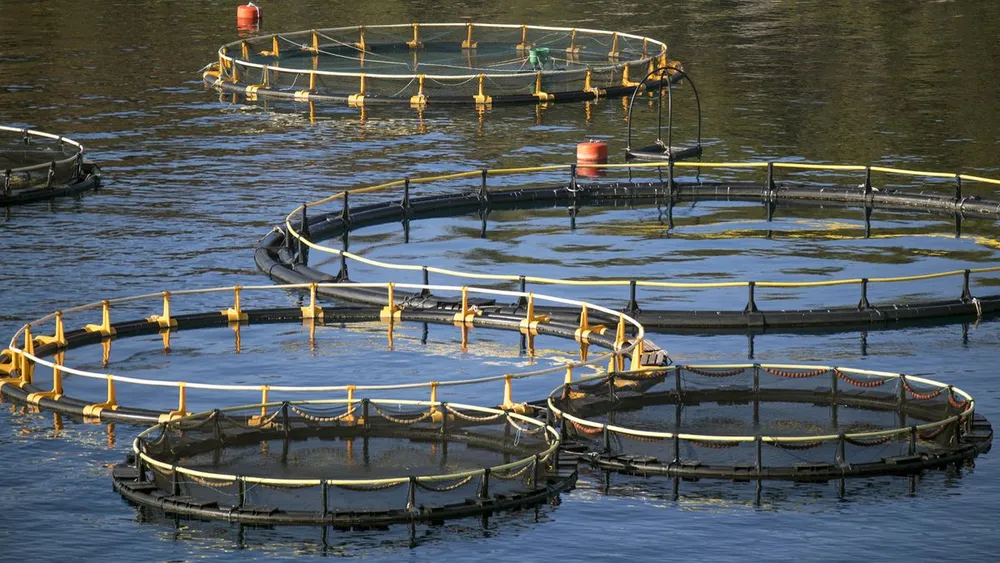
Minimize Losses, against the backdrop of the continuous development of the marine aquaculture industry, this sector is shifting from capacity expansion to efficiency competition. Avoiding biomass loss caused by wave impacts is no longer merely a maintenance task; it has become a key factor for operational stability and profitability. This guide explains how to protect your investment through advanced engineering technologies and standardized management.
1. Structural Optimization: Minimize Losses High-Performance Cage Design
To disperse the impact force of waves, using anti-wave circular fences for transition is extremely necessary.
The mechanics of stability: The circular design can evenly distribute fluid pressure, thereby avoiding damage to local structures.
Deep-sea solution: For offshore operations, large gravity cages are the industry standard configuration. By adopting integrated bottom weights and reinforced floating frame structures, these systems can provide a stable working environment, while traditional simple cages cannot compare with them.
2. Engineering Defense: Buffers and Protective Systems
Adding a protective layer can alleviate the physical burden on the main network.
Dual protection measures: Setting up an outer breakwater can effectively reduce the strength of the waves before they reach the main cage.
Standardized hardware: Using thickened high-density polyethylene pipes, along with high-strength clamps and marine-grade bolts. This ensures that the connecting parts remain intact during typhoons, preventing severe loosening or breakage.
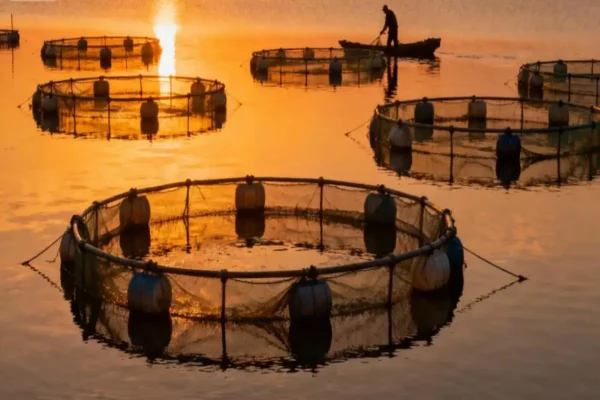
3. Scientific Site Selection & Intelligent Layout
The site selection process is the first line of defense against environmental risks.
Natural shelter areas: The priority is to choose the windward side of islands and the inner bay areas to avoid the main paths and strong current areas of typhoons.
Fluid dynamics alignment: Place the hoist cages parallel to the prevailing wind direction and the flow direction. This can reduce resistance and friction, thereby ensuring the structural integrity of the anchoring system.
Collision prevention measures: Maintain the set spacing between each group to prevent collisions between groups in extreme weather conditions.
4. Proactive Maintenance: Shifting to a Preventative Model
The meticulous daily operations are like the “software” that protects the “hardware”.
Routine integrity checks: Conduct wear inspections of the nets weekly and audit the anchor chains and buoys monthly.
Biofouling control: Regularly use high-pressure water guns to remove seaweed and shellfish. Reducing the biological load can reduce the weight and resistance of the nets, thereby maintaining the best permeability and oxygen content of the nets.
Adaptive density management: Adjust the farming density according to seasonal wave predictions. During high-risk periods, reducing the density can alleviate the mechanical load on the nets.
4. Proactive Maintenance: Shifting to a Preventative Model
The meticulous daily operations are like the “software” that protects the “hardware”.
Routine integrity checks: Conduct wear inspections of the nets weekly and audit the anchor chains and buoys monthly.
Biofouling control: Regularly use high-pressure water guns to remove seaweed and shellfish. Reducing the biological load can reduce the weight and resistance of the nets, thereby maintaining the best permeability and oxygen content of the nets.
Adaptive density management: Adjust the farming density according to seasonal wave predictions. During high-risk periods, reducing the density can alleviate the mechanical load on the nets.
5. Emergency Response: Strategic Mitigation
Once a storm warning is received, immediate and rapid reinforcement must be carried out. If indoor relocation is not possible, all anchor chains must be tightened and the framework fixed to the fixed points with high-strength ropes to reduce shaking and structural fatigue.
Reducing losses is the first step towards achieving long-term profitability. Our standardized circular aquaculture system (RAS) and reinforced deep-sea cages have been meticulously designed to withstand the harshest environmental conditions while also reducing labor costs. Join the ranks of those global leaders who are leading the way in sustainable agriculture through precise and stable approaches.