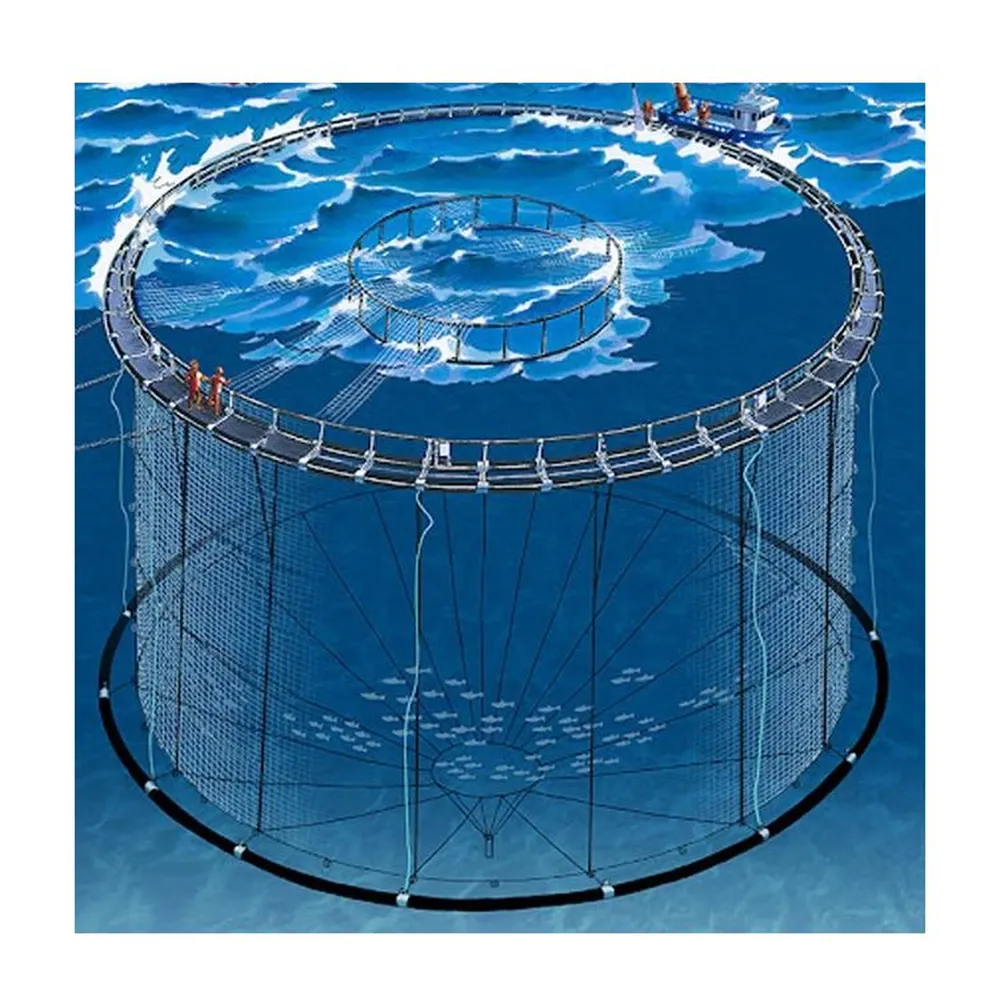
The role of netting in preventing fish and shrimp from escaping
In cage aquaculture, fish and shrimp can escape due to issues with the netting. To prevent this, the key is to use high-tensile-strength polyethylene (PE) netting. Its core advantage lies in combining the inherent properties of polyethylene with enhanced mechanical properties, making it suitable for the complex environments of both marine and freshwater aquaculture. Specific advantages can be broken down as follows:
1. Superior Tensile and Tear Resistance
High-tensile-strength PE netting, through polymer modification (such as adding reinforcing agents, using high-density polyethylene (HDPE) or ultra-high molecular weight polyethylene (UHMWPE)) and special weaving processes (such as multi-strand twisting and double-layer dense weaving), achieves a 30%-80% increase in tensile strength compared to ordinary PE netting, while maintaining a controlled elongation at break within a reasonable range (typically 15%-30%). 1. **Resistant to continuous impacts from strong winds, waves, and ocean currents, reducing the risk of mesh stretching, deformation, or breakage;** It can withstand the impact of fish schools (such as the movement of fish in high-density aquaculture or competition during feeding), reducing fish losses due to mesh damage.
2. Strong Corrosion Resistance and Environmental Adaptability:
Polyethylene itself has excellent chemical stability. High-tensile-strength PE mesh further optimizes its anti-aging formula: It is resistant to corrosion from seawater, freshwater, acids, alkalis, and salts, showing no swelling or degradation even after long-term immersion. Compared to nylon (PA) mesh, it avoids strength reduction caused by seawater salinity; The addition of UV-resistant additives enhances its anti-aging capabilities, extending its service life to 5-8 years under outdoor exposure (compared to only 2-3 years for ordinary PE mesh), making it suitable for open aquaculture environments such as nearshore and offshore areas; It maintains flexibility even at low temperatures (embrittlement temperature as low as -60℃), preventing cracking due to winter low temperatures, making it suitable for northern sea areas or cold-water aquaculture scenarios.
3. Lightweight and Ease of Operation
Compared to metal netting (such as stainless steel mesh) or high-strength nylon netting, high-tensile PE netting has a low density (0.91-0.96 g/cm³), combining high strength with lightweight construction:
Its overall light weight facilitates the installation, replacement, and maintenance of the net cages, reducing labor and hoisting equipment costs;
Its moderate buoyancy in water prevents deformation of the net cage frame due to excessive weight and avoids excessive floating that could affect the netting’s fit;
Its smooth surface reduces frictional damage to the fish’s body surface, lowering the probability of disease infection.
4. Wear Resistance and Long Service Life
The fiber surface of the specialized PE netting undergoes wear-resistant modification treatment, and the weaving nodes are reinforced by heat fusion, significantly improving wear resistance:
It resists frictional wear between the netting and hard objects such as the net cage frame, anchor chains, and reefs, reducing localized damage;
It has better resistance to biofouling than ordinary PE netting (the smooth surface is less prone to barnacles and algae growth), reducing cleaning frequency, indirectly extending service life and reducing maintenance costs.
5. Cost-Effectiveness and Sustainability
Compared to ultra-high-strength fibers such as UHMWPE and aramid, high-tensile PE netting has a lower raw material cost (only 1/3 to 1/2 of UHMWPE) and a mature production process.
While meeting the requirements of aquaculture intensity, it significantly reduces the overall cost of the net cages, offering outstanding cost-effectiveness.
It is recyclable and reusable, aligning with the trend of environmentally friendly aquaculture. Some modified PE netting is also biodegradable (requires specific formulation), reducing the risk of marine plastic pollution.
6. Adaptability to Diverse Aquaculture Scenarios
High-tensile PE netting can be customized in specifications (such as mesh size and wire diameter) according to the aquaculture species and marine environment:
Deep-sea net cages: Resistant to strong currents and winds, ensuring structural stability of the net cages;
High-density aquaculture: Withstands the pressure of high-density fish populations, reducing the risk of fish escape;
Freshwater large-scale aquaculture: Resistant to acids and alkalis, anti-aging, suitable for long-term aquaculture in lakes and reservoirs.
In summary, this type of netting retains the weather resistance and lightweight properties of polyethylene material, while also overcoming the shortcomings of ordinary PE netting in terms of insufficient tensile strength through technological upgrades. It is the core consumable choice for large-scale and intensive aquaculture.