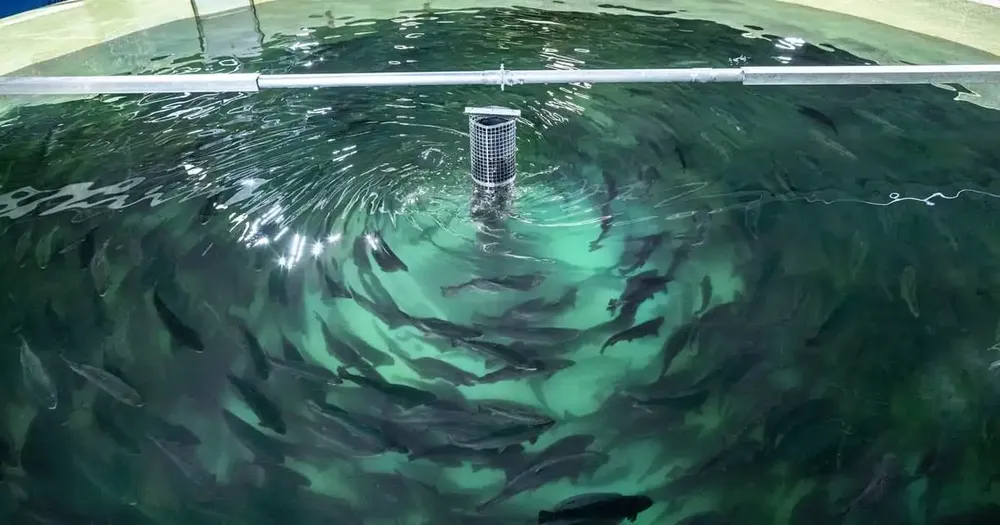
— The High-Density and Stable Production Path of RAS
In traditional intensive aquaculture, people are often the ceiling of production capacity: monitoring water quality, adjusting equipment, removing sludge, feeding fish, patrolling tanks—every task relies on experience and manual labor.
When farming scale expands or stocking density increases, one core contradiction becomes more obvious: How can production be increased without adding more workers?
The key solution lies in fundamentally changing the production model—introducing a RAS system. This is not just an upgrade of equipment, but a continuous, high-density, high-efficiency production model with low labor input.
Fully Automated Water Treatment: Reducing Daily Manual Work
The core of RAS is maintaining a stable and controllable water environment.
In traditional farming, water exchange, sludge removal, and water-quality adjustment consume a large amount of labor and still produce unstable results.
A RAS forms a closed-loop water treatment chain through a series of automated devices.
Auto-backwash drum filters and stable protein skimmers remove solids and discharge waste during operation, without requiring workers to frequently clean filter screens or manually handle sludge.
The more continuous the filtration, the less likely the water quality will deteriorate suddenly. Meanwhile, biological filtration combined with efficient filter media keeps nitrification active over the long term, reducing management difficulty. When the media structure is more scientific and biofilm forms faster, ammonia and nitrite are easier to maintain within safe limits, lowering dependence on experienced technicians.
This entire combination ensures long-term clean and stable water quality. Once the system matures, it becomes extremely stable and is the key to reducing labor intensity.
Automated Feeding: Keeping Fish Growth More Consistent
Feeding is the core cost of farming.
Traditional manual feeding is often random, wasteful, and labor-intensive.
Intelligent feeders operate automatically based on settings, achieving timed, quantitative, and split feeding. This improves feed utilization, reduces waste, and keeps fish growth more consistent.
When feeding shifts from “people” to “systems,” management becomes more controllable, and production increases steadily.
Online Water-Quality Monitoring: Making Management Proactive Instead of Reactive
Manual water checking cannot achieve large-scale or precise management, nor can it detect problems in time. It is always reactive.
Online monitoring collects real-time data on key indicators (dissolved oxygen, temperature, pH, ammonia, nitrite, etc.). When trends start to fluctuate, the system provides early warnings.
This allows workers to detect issues immediately without constant patrols.
Labor is freed from repetitive water checking and tank inspections. Management becomes safer and more efficient, and labor requirements decrease.
By shifting from “experience-based management” to “data-based management,” one worker can oversee multiple systems.
Automation Drives Production Growth
When filtration, feeding, and water quality monitoring are all automated, your RAS system can achieve high-density, stable production per unit of water while reducing manual management.
With minimal supervision, efficient equipment operation, consistently stable water quality, and lower disease risk, the stocking density can be further increased…
This is the meaning behind modern RAS transitioning from “manual management” to “intelligent management”—not only a solution to rising labor costs, but also the inevitable path for aquaculture to move toward industrialization, modernization, sustainability, and high profitability.
Other Solutions
Key components for land-based and Marine aquaculture systems
January 4, 2026
How to Avoid Fish and Shrimp Losses in Cage
December 22, 2025