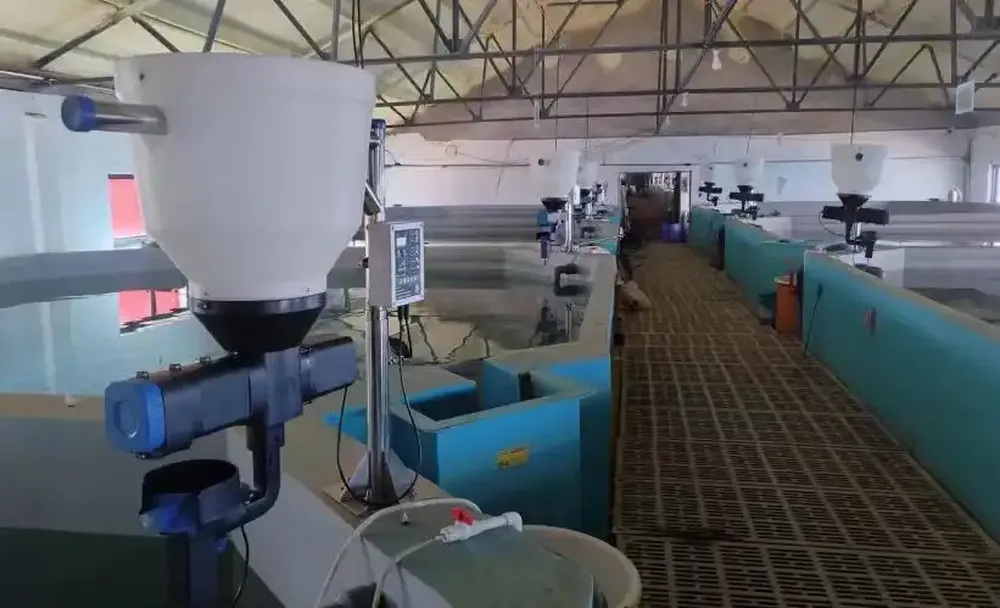
In aquaculture production, feed always accounts for the largest share of total costs. As raw material prices continue to rise, feed becomes increasingly expensive. However, in real farming operations, the amount of feed that actually ends up being consumed by fish is far lower than the total amount fed.
Incorrect feeding methods often result in feeding more but achieving slower growth—higher costs with disproportionately low returns. To reduce waste, the key is not “feeding less,” but feeding precisely.
Are These Common Problems in Manual Feeding?
Relying on experience makes it difficult to keep feeding quantities consistent. Feeding is often uneven, leading to unequal feed intake among fish and obvious size differentiation. During busy periods, feeding may not be carried out on time, and irregular feeding schedules disrupt growth rhythms. Feeding data cannot be accurately recorded, making post-analysis and optimization impossible.
Over time, these issues often lead to hidden feed losses of 20%–30%, while also increasing the organic load on the water and adding pressure to downstream water-treatment systems.
Intelligent Feeders Make Feeding Simpler, More Accurate, and More Cost-Efficient
The value of intelligent feeding machines lies in making the feeding process settable, adjustable, and traceable. Reducing waste is, in itself, a form of cost saving.
Feeders support precise dispensing of different feed sizes and allow flexible adjustment of feeding strategies according to different growth stages.
Timed, fixed-point, and quantitative feeding modes help fish develop a stable feeding rhythm. More uniform feed distribution reduces competition and leftover feed, improving feed utilization efficiency.
With “system-based feeding,” every feeding action becomes more precise, and waste naturally decreases.
Managing Feeding Through Data for Real Cost Control
Compared with traditional methods, another core advantage of intelligent feeders is data recording for review and remote management.
Feeding frequency and feed quantities can be viewed in real time remotely, allowing clear visibility of system operation. If abnormalities occur in a specific tank, managers can quickly trace feeding records and adjust parameters in time, instead of reacting only after problems escalate.
Precise Feeding Brings More Than Feed Savings
When feed waste is effectively controlled, the benefits extend far beyond cost reduction. Water becomes cleaner, water-quality fluctuations decrease significantly, filtration and maintenance pressure are reduced, fish grow more uniformly, disease risks decline, survival rates become more stable, and unit output continues to increase.
In practical applications, reducing feed waste by around 30% through intelligent feeding optimization is not the goal—it is the result.
Feed prices are not something farmers can control, but whether feed is truly utilized can be managed.
By achieving precise feeding through intelligent feeders—replacing experience with equipment and guiding decisions with data—farms can maintain long-term competitiveness in a high-cost environment.
What is truly saved is not only feed cost, but also labor input and management risk.