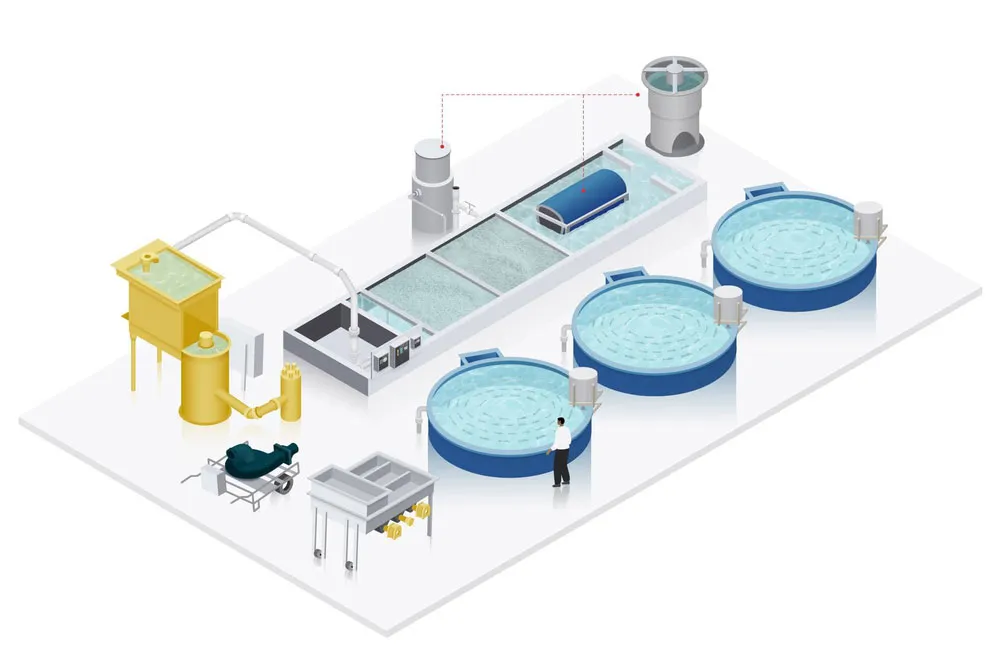
This is an explanation of Recirculating Aquaculture Systems. People also call them RAS. This system is a way to farm fish. It uses tanks on land. The water in the tanks is cleaned and used again. This is different from traditional fish farming. Traditional farming often uses ponds or cages in open water.
A RAS has several main parts. It is important to know how these parts work together.
The first part is the fish tank. This is where the fish live. The tanks are usually round. The shape helps the water move in a circle. This movement keeps waste from settling in one place.
The second part is a mechanical filter. When fish eat, they produce waste. Solid waste goes into the water. The mechanical filter removes these solid particles. It works like a screen or a sieve. It takes the small pieces of dirt out of the water.
The third part is a biofilter. This is a very important part. Fish release ammonia through their waste and gills. Ammonia is toxic to fish. It can make them sick or die. The biofilter has good bacteria living on it. These bacteria eat the ammonia. They change the ammonia first into nitrite, which is also bad, and then into nitrate. Nitrate is less harmful to fish.
The fourth part is an oxygen injector. Fish need oxygen in the water to breathe. In a RAS, the water is inside a tank. It does not get oxygen from wind or plants easily. A machine called an oxygen generator puts oxygen directly into the water. This keeps the fish healthy.
The fifth part is a pump. The pump moves the water. It pushes water from the tank through all the filters. Then it sends the clean water back to the fish tank. The water is always moving in a loop.
The sixth part is sometimes a UV sterilizer. This unit uses ultraviolet light. The light kills very small germs in the water. It controls the spread of disease. Not every system has this, but it is common.
There are reasons why people use this system.
One reason is water use. A RAS uses very little new water. It is a closed loop. You only add water to replace what is lost. Water is lost through evaporation or during cleaning. This is good for places with little water.
Another reason is land use. You do not need a large piece of land by a river or lake. You can build a RAS anywhere. You can put it close to a city where people buy fish. This reduces the cost for transport.
Another reason is control. You control the environment in the tank. You control the temperature. You control the oxygen level. You control the light. This means the fish can grow all year. Bad weather outside does not stop the farm.
Another reason is waste management. The waste from the fish is collected. It is not released into rivers or lakes. This is better for the environment. The collected waste can sometimes be used as fertilizer for plants.
There are also some challenges with this system.
The first challenge is cost. Building a RAS costs a lot of money. The tanks, pumps, and filters are expensive. The systems also use electricity all the time. The cost of power is high.
The second challenge is management. The system needs constant watching. A person must check the water quality every day. If the biofilter stops working, the fish can die quickly. If the pump fails, the fish will not get oxygen. This requires skill and attention.
The third challenge is disease. Because the fish live in a dense group, disease can spread fast. If one fish gets sick, many fish can get sick. The farmer must be very careful about fish health.
In conclusion, a Recirculating Aquaculture System is a method of farming fish indoors. It filters and reuses water. It has advantages like saving water and allowing location flexibility. It also has disadvantages like high cost and need for careful management. This system is important for the future of fish farming. It provides a way to produce more food as the demand for fish grows.