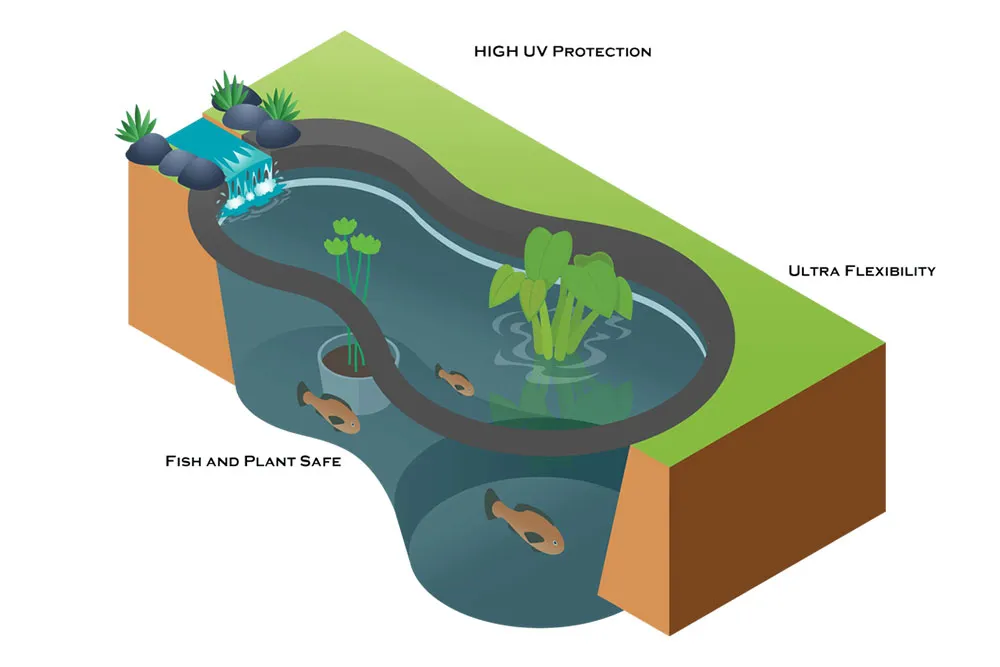
This is an explanation of fish pond liners. A pond liner is a sheet of material. It is placed on the bottom and sides of a pond. Its job is to hold water in. It stops water from leaking into the ground. People use pond liners for fish farming. They are also used in garden ponds and for water storage.
A pond liner creates a barrier. Without a barrier, water can seep through soil. Sandy soil loses water very fast. Clay soil holds water better. But a liner makes sure that no water is lost. This is important for a fish farm. Water is a main resource. Losing water means losing money and time.
There are different types of pond liner materials. Each material has different properties.
One common material is PVC. PVC stands for Polyvinyl Chloride. It is a type of plastic. PVC liners are flexible. They are strong. They can last for many years. They are usually a good price. Many fish farms use PVC liners.
Another common material is EPDM. EPDM stands for Ethylene Propylene Diene Monomer. It is a type of rubber. EPDM liners are very flexible. They can stretch without tearing. They are good for ponds with an uneven shape. They are also very strong against sunlight.
A third material is HDPE. HDPE stands for High-Density Polyethylene. This plastic is very tough. It has a high resistance to chemicals. It is not as flexible as PVC or EPDM. It is often used for large commercial projects. It is known for its long life.
Another material is LLDPE. LLDPE stands for Linear Low-Density Polyethylene. This material is flexible. It is also strong. It is often less expensive than HDPE. It is a good choice for many small and medium ponds.
The installation of a pond liner is a step-by-step process. Doing it correctly is very important.
The first step is to dig the pond hole. The hole must have the correct shape. All sharp objects must be removed from the hole. Rocks, roots, and sticks can puncture the liner. The bottom of the hole is then smoothed and packed down.
The second step is to add a layer of protection. Often, a layer of sand is put down. Another option is a geotextile fabric. This fabric is a special cloth. It cushions the liner. It sits between the ground and the liner. It protects the liner from sharp things.
The third step is to unfold the liner. The liner is placed over the hole. It is centered so that there is extra material on all sides. The liner is then pressed into the shape of the hole. It should be smooth against the bottom and sides.
The fourth step is to fill the pond with water. The water helps to push the liner into place. The weight of the water removes wrinkles. The liner will stretch and form to the hole. The extra liner material around the edge is left for now.
The fifth step is to trim the extra liner. After the pond is full, the extra material is cut off. Only a small amount is left around the edge. This edge is then secured. It can be buried in a small trench. It can be held down with stones.
There are reasons why people use pond liners.
One reason is water security. The liner prevents water loss. This means the water level stays constant. The farmer does not need to add new water often. This saves water and money.
Another reason is control. A liner creates a closed environment. It stops chemicals from the soil from mixing with the pond water. It also stops outside weeds from growing into the pond.
Another reason is flexibility. A farmer can build a pond anywhere with a liner. The farmer does not need to find a place with clay soil. A pond can be built on rocky land or sandy land.
There are also some challenges with pond liners.
The first challenge is cost. A good quality liner costs money. For a very large pond, the cost can be high.
The second challenge is damage. Liners can be punctured. Sharp objects can make holes. Animals can sometimes damage the liner. A hole in the liner will cause a leak. A leak can be hard to find and repair.
The third challenge is installation. Installing a liner needs care and labor. If it is not done correctly, it will not work well. Folds and wrinkles can become weak points.
In conclusion, a fish pond liner is a barrier that holds water in a pond. It is made from materials like PVC, EPDM, or HDPE. It is installed in a careful process. It helps farmers save water and build ponds in more places. It is a key tool for modern aquaculture.