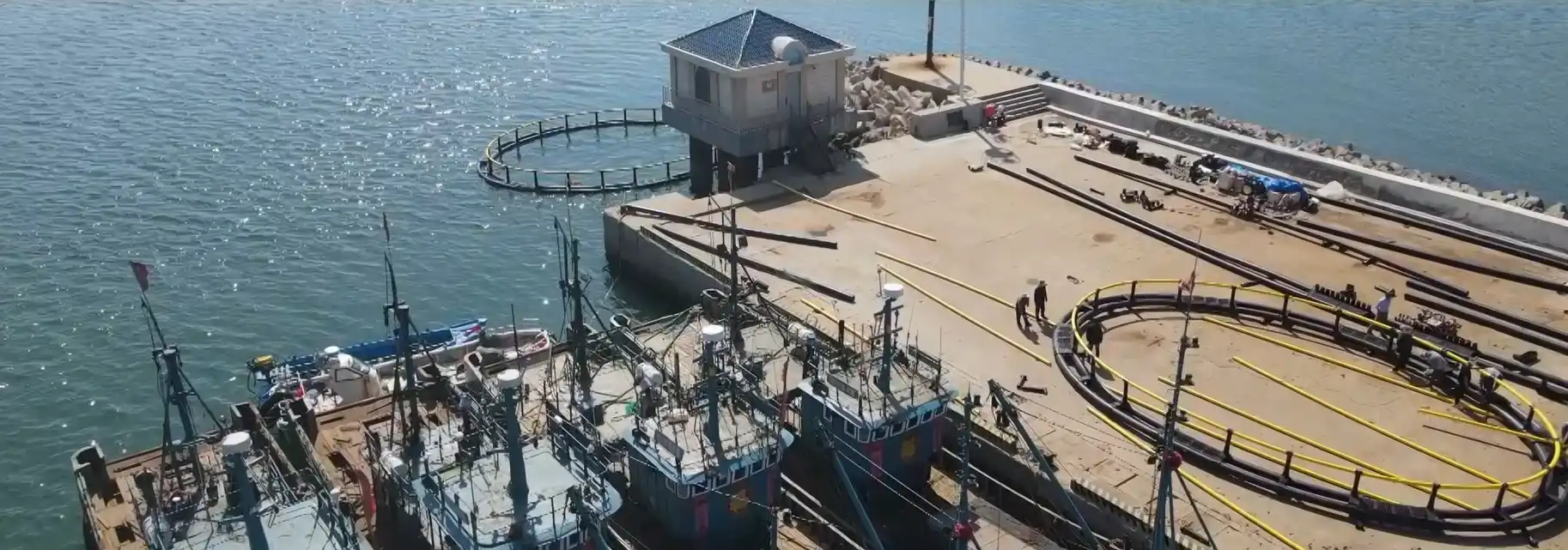
1. Background & Challenges: Overcoming Rough Seas and Low Yields
Yantai Yangma Island is a premier open-sea aquaculture hub in Northern China, boasting exceptional water quality. However, the sea area faces severe hydrological challenges, including high wave energy, strong open-ocean currents, and frequent late-summer typhoons from the West Pacific. These conditions impose strict structural safety demands on marine fish farming infrastructure.
The client, an experienced local farmer specializing in premium Black Rockfish (Sebastes schlegelii), approached us facing critical operational bottlenecks:
-
Low Biomass Yields: Their legacy traditional wooden and flimsy plastic cages suffered from poor water exchange, limiting the optimal stocking density. Increasing the fish population in these setups risked hypoxia and catastrophic disease transmission.
-
High Extreme Weather Risks: Every typhoon season brought severe risks of structural deformation or collapse, leading to mass fish escapes and immense financial loss.
-
Time-Critical Deadline: With the optimal fingerling stocking window closing in exactly one week, the client urgently required an industrial-grade solution to scale up production safely.
Project Target: Deploy an advanced deep-sea anti-wave cage system capable of surviving Category 12 typhoons, entirely manufactured, welded on-site, and anchored within a strict 7-day timeline.
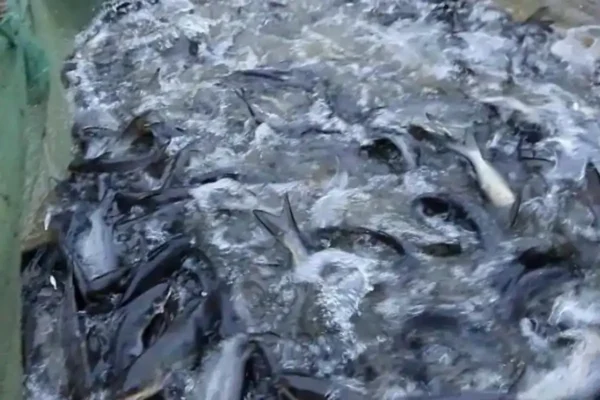
2. Solution: Eco-Friendly HDPE High-Performance Deep-Sea Circular Cages
To withstand the rigorous marine physics of Yangma Island and match the bottom-dwelling behavioral patterns of Black Rockfish, our engineering team customized 7 units of 20m diameter eco-friendly HDPE deep-sea circular cage systems.
Structural Integrity & Material Science
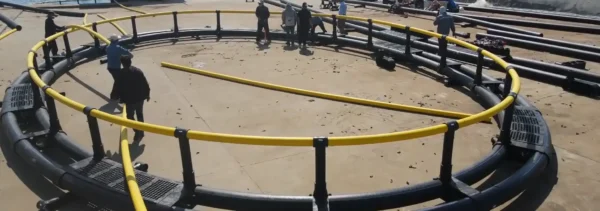
The cage framework is engineered from premium High-Density Polyethylene (HDPE) raw materials, extruded seamlessly for optimal flexibility and UV-aging resistance. At a diameter of 20m, each cage provides an expansive circumference of 62.8m and a vast volumetric culture space. The dual-pipe floating collar absorbs kinetic wave energy via elastic deformation, completely avoiding brittle structural failures under extreme hydrodynamic loads.
3. On-Site Execution: Precision Thermofusion Welding Under a 7-Day Deadline
In commercial aquaculture, missing the fingerling release window means a lost year of revenue. To execute this emergency deployment, our site engineering division initialized an accelerated round-the-clock workflow:
-
Days 1 – 2 (Logistics & Mobilization): Precision-cut HDPE pipes, heavy ballast systems, and heavy-duty anti-escape nets were mobilized to the Yantai coastal dock. Specialized thermal welding engineers arrived on-site.
-
Days 3 – 5 (Hydraulic Thermofusion Welding): Utilizing automated hydraulic butt-fusion welding machines, joints were fused at a precise temperature of 220°C. This achieved a joint strength factor (matching the native pipe strength). Every single weld underwent 100% airtight and non-destructive testing to ensure zero structural failure over a 15-year lifecycle.
-
Days 6 – 7 (Assembly, Net Rigging, and Towing): The framing elements, stanchions, and brackets were fully integrated. Anti-fouling nets were attached with precision sinker rings. Under optimal tide conditions, professional tugboats towed all 7 systems to the offshore concession for precise multi-point grid anchoring.
Result: All 7 large-scale cages were fully commissioned in exactly 7 days, allowing the client to safely stock their high-value Black Rockfish fingerlings right on schedule.
4. Commercial Impact & ROI: Industrial Scaling and Asset Protection
With an effective culture volume exceeding 1,500 cubic meters per cage, the open-ocean current flow guarantees an environment rich in dissolved oxygen. This optimized hydrodynamic environment accelerates metabolic growth, improves FCR (Feed Conversion Ratio), and delivers a massive capacity expansion:
Based on comparative historical datasets across identical hydrological regions, this advanced HDPE system is projected to increase the client’s safe stocking density by at least 30%. Concurrently, the smooth, bio-inert properties of our marine-grade HDPE significantly lower marine biofouling attachment, reducing manual net-cleansing labor overhead by 40%. This successful deployment transitions the client from high-risk traditional farming into a highly profitable, climate-resilient offshore aquaculture enterprise.
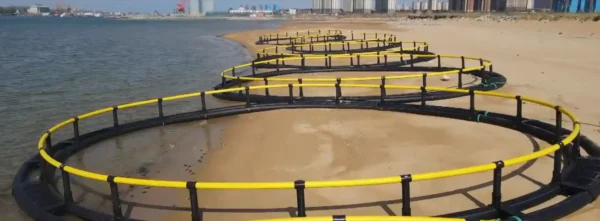
Don’t let legacy, low-yield cages hold back your business or leave your assets vulnerable to the next big storm. Whether you need a rapid, crisis-response equipment deployment within a week or a custom-engineered deep-sea infrastructure plan, our engineering team is ready to deliver.
Ready to upscale your farm’s productivity and secure your investment against the harshest offshore environments?